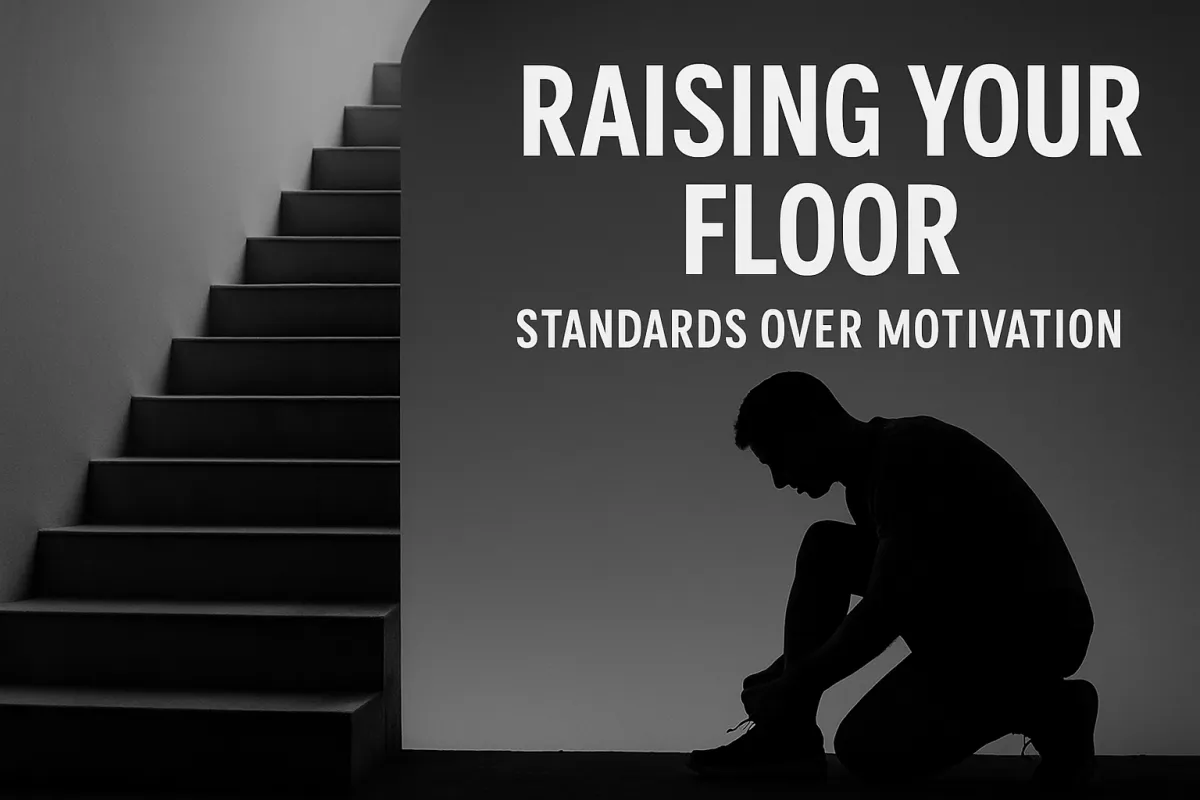
Raising Your Floor - Standards Over Motivation
Why Standards Matter More Than Motivation
People love talking about goals.
Millionaire by 30.
Six pack by summer.
New routine on Monday.
But if you look closely, most lives are not being driven by goals at all.
They are being quietly run by something else.
Standards.
Not what you hope to do.
What you refuse to drop below.
That is what builds your life.
In this entry, I want to break down:
What standards actually are
Why your “floor” matters more than your “ceiling”
How to choose a minimum standard that never drops
How to raise it without burning out
A simple framework you can use this week
If you have ever had a random burst of motivation at 2 a.m., planned your whole new life, then woke up and did none of it, this is for you.
What Standards Really Are
We are used to thinking in “highs.”
Best workout.
Best day.
Best version of yourself.
But your life is not built on your best days.
Your life is built on your average ones.
Standards are not the days you post.
They are the ones you hide.
They are:
What you still do when you are tired
What you still do when you are stressed
What you still do when no one is checking on you
You have standards already.
They might not be intentional ones.
Scrolling before you get out of bed.
Eating whatever is closest when you are tired.
Sleeping late even when you know you will regret it.
Letting “I am exhausted” turn into three days off instead of one.
Those are standards too.
Just low ones.
The question is not “Do I have standards?”
The question is “Are my standards building the life I say I want?”
Goals vs Standards: Floor And Ceiling
On group calls, I see this pattern a lot.
People say:
“I want to get back in shape.”
“I want to be more disciplined.”
“I want to stop starting over.”
The goals are big.
The standards are small.
James Clear said it well.
You do not rise to the level of your goals.
You fall to the level of your systems.
I would add:
You fall to the level of your standards.
Think of it like this:
Your ceiling is what you are capable of on your best day
Your floor is what you still do on your worst day
Most people try to raise their ceiling.
More workouts.
More habits.
More rules.
But their floor does not move.
They still have days where everything collapses.
They still have weeks where “off track” means “nothing at all.”
They still let one bad day become a bad month.
Life does not punish you for not hitting your ceiling.
It punishes you for how low you are willing to let your floor go.
The Old Kaizen And The Floor Problem
When I was younger, my life had no consistent floor.
There were seasons where I did everything in one day.
School during the day.
Work at night.
Gym two or three times a week in between.
No sleep.
No plan.
Just brute force.
Then there were seasons where I did almost nothing.
Bed rotting.
Escaping.
Letting days disappear.
High ceiling.
No floor.
If you looked at one “highlight day,” you would think my life was on track.
If you looked at a random Tuesday, it told the real story.
That is what low standards do.
They make your life depend on random spikes of willpower.
Now, even with a concussion, even on my worst days, I still outwork old versions of myself.
Not because my goals got bigger.
Because my minimum got higher.
There is no version of my day where:
I do not move my body at all
I completely abandon my health
I go multiple days without training in some form
I stop building Kaizen Infinity entirely
My ceiling improved.
But the real shift was this:
My worst day now used to be a good day for an older version of me.
That is what happens when you raise your floor.
Standards Are Identity In Disguise
Standards sound like behavior.
They are really identity.
“I always do something physical, even if it is just stretching.”
“I do not scroll before I start my day.”
“I keep my word to myself.”
Those are not just tasks.
They are identity statements.
Every time you act below your standard, you remind yourself:
“I do not really mean what I say.”
Every time you protect your standard, you remind yourself:
“I am someone who follows through.”
This is why “one more day off” feels small in the moment and heavy later.
It is not about the workout you missed.
It is about the person you trained yourself to be.
Standards are the proof your future self will look back on.
Or the lack of it.
How To Choose A Standard That Actually Matters
You do not need ten new standards.
You need one that counts.
Pick a standard in an area that affects everything else:
Health
Sleep
Training
Food
Focus
Work quality
Self respect
Good standards are:
Clear
Measurable
Boring
Repeatable
“Eat better” is not a standard.
“Cook one simple meal at home five nights a week” is.
“Train more” is not a standard.
“Move my body intentionally at least 20 minutes every day” is.
“Be more disciplined” is not a standard.
“Phone stays away for the first 30 minutes after I wake up” is.
Standards should feel slightly uncomfortable, not impossible.
If your old self hears it and thinks “That is a lot,” you are probably in the right place.
Raising Your Floor: The Standards Blueprint
Here is a simple structure you can use right now.
1. Find your real floor
Forget your best days.
Look at your worst realistic days.
Not the day you are in the hospital.
A normal bad day.
After a long shift.
After an argument.
After poor sleep.
Ask:
“What do I usually still do on those days?”
Be honest.
Maybe it is:
Scroll
Eat whatever
Skip workouts
Stay up late
Avoid messages and responsibilities
That is your current floor.
Whether you like it or not.
Write it down.
You cannot raise what you will not face.
2. Decide your future self’s floor
Now go in the opposite direction.
Picture yourself one to five years from now.
Not the fantasy version.
The version you actually want to become.
Ask:
“On their worst day, what do they still do?”
Maybe that version of you:
Still hits protein and water targets
Still moves for at least 20 minutes
Still sleeps at a reasonable hour
Still handles one important task for the day
Still keeps one promise they made to themselves
Write it.
This is not about perfection.
It is about standards that would make your current life better even if nothing else changed.
3. Choose one standard you refuse to drop below
You do not need to upgrade everything.
Choose one standard.
It might be:
“No matter what, I move my body intentionally every day.”
“No matter what, I cook once a day.”
“No matter what, I am in bed by a certain time.”
“No matter what, I track my food.”
“No matter what, I spend 15 minutes on something that builds my future, not just maintains my present.”
The rule is simple:
This standard is non negotiable.
You can have bad days.
You can feel off.
You can adjust intensity.
But you do not drop below it.
4. Make the standard small and heavy
Small enough that you can do it on a bad day.
Heavy enough that it actually moves your life.
“Read for three hours every night” is big and fragile.
“Read ten minutes every night” is small and durable.
“Gym for two hours daily” is big and fragile.
“Twenty minutes of movement daily” is small and durable.
If the standard breaks every time life gets loud, it was never a standard.
It was a wish.
Design it so that even sick, tired, stressed you can still say:
“I can do this.”
Then prove it.
5. Let time do the talking
At first, your standard will feel small.
It will not impress anyone.
Good.
Standards are not meant to impress.
They are meant to anchor.
Over time, something quiet happens:
The days you fully fall off disappear
Your “bad” days start to look like old “good” days
Your ceiling moves up without you chasing it
What used to be a big deal becomes your normal.
For one client, “three workouts a week” used to sound impossible.
Months later, that became her bare minimum.
Now, even on a chaotic week, she hits it without thinking.
That is a raised floor.
You do not notice it happening in the moment.
You only notice when you compare this year’s “worst” to last year’s “best.”
The Hidden Cost Of Low Standards
Low standards do not ruin your life overnight.
They erode it quietly.
You miss one workout.
Then two.
You stop tracking.
You stop planning.
You stop checking in.
Nothing explodes.
You just wake up three months later wondering why you feel like a stranger in your own life.
The danger is not one bad day.
The danger is what you allow that bad day to teach you:
“That it is okay to abandon yourself.”
Every time you protect your standard, even in a small way, you teach yourself the opposite:
“I can trust me.”
That trust is worth more than any short term result.
How To Start Raising Your Floor This Week
You do not need a full system.
You just need one decision.
Today:
Write down your current floor on a bad day
Write down your future self’s floor
Choose one standard in between that you can start living now
This week:
Protect that standard at all costs
Expect resistance
Expect laziness
Expect old patterns
Hold the line anyway.
This month:
Notice how many “bad days” you still have
Notice how far they pull you down compared to before
Notice who you are becoming as someone who keeps their own standard
That is the real win.
Final Question
You already know what it feels like to live with low standards.
To break your word to yourself.
To let your worst days erase your best efforts.
So here is what matters now:
If your future self could see how you live on your worst day today,
would they be proud of your floor
or embarrassed by it?
You get to decide that.
One standard at a time.
Back to work.


